Feed on
Posts
Comments

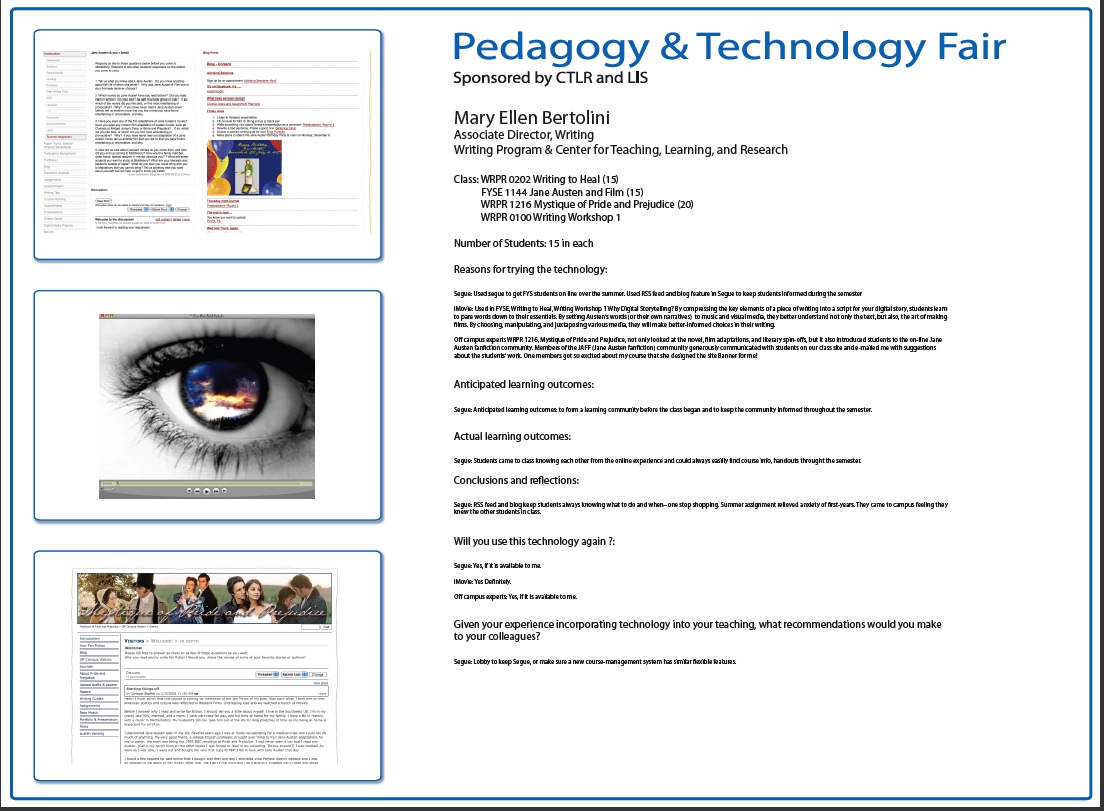
Tech Fair

Participated in Teaching with Technology,

Tech Fair, Co-sponsored by the CTLR and LIS @ Middlebury on Thursday, June 4th.

I looked at some of the ways I’ve used technology in four classes:

Mack made posters for all of us who presented:

I had such fun speaking to Jasna-VT last Sunday about Jane Austen’s Persuasion! Janites Deb and Kelly have created an articulate and welcoming group that sponsors a variety of Jane-related talks and events throughout the year. One of my favorites has been the Birthday Tea complete with Regency Dancing by the Burlington Country Dancers.

The great joy I felt in speaking to this group came from the fact that the audience knew their Austen backwards and forwards– not only Persuasion, which was Sunday’s topic, but the whole Austen corpus as well.  I love to introduce Austen to my students, some of whom have only a fleeting film familiarity with her work before the course begins, but what a treat to share my thoughts with the Jane Austen Choir in Vermont!

Thank you, Janites in Vermont and everywhere.

I don’t ordinarilly talk about my personal life too much on this blog, but our local campus newspapers did a Valentine article about campus couples, and I can’t resist linking to it here. Mr. B. and I are the first couple.

Time

One of the wonderful things about working at Middlebury College is that every three Januarys, I have a month off from teaching. Don’t get me wrong. I love teaching, and my students bring me great joy, but a bit of time away from the classroom means time for longer projects, time to indulge in a sustained thought.  This January, I’m working on two projects: revision for an article about how I use writing workshops in my Writing to Heal course and preparation for a JASNA-VT talk on Jane Austen’s Persuasion. Certainly, immersing myself in the Peninsular War and the Convention of Cintra have helped me weather the snow, ice, and cold that has descended on northern New England this year.

The National Resource Center 21st International Conference on

The First Year Experience

Dublin Ireland

June 23-26, 2008

Presentation:

FYS as a Locus for Faculty Development: Creating Mini Learning Communities

Handouts:

Dublin:minicommunities

Moved to WP

MT blogs have been down for a bit at Middlebury, but one by one they are resurfacing on WordPress.

Yesterday, I was asked how to conduct a writing workshop without a particular paper due. Although nothing can quite replace the immediacy of a newly-written paper, we and our students can benefit greatly from a look at past work. In fact, sometimes a little distance from the due date of the assignment can add a much-needed perspective to the writing discussion.

One of my favorite non-specific paper exercises is Sentence Clinic. I ask students to do the following before class.

Write down two sentences from your paper or journals we will discuss today :
1. A sentence that you think worked well, one that makes you feel proud (Why do you like this sentence?)
2. A sentence that never quite worked, one that we will look at in the sentence clinic (Why do you think this sentence does not work?)

During class, we use this worksheet. What happens in this exercise is two fold. First, students articulate what they like about their good sentences. From this discussion, we can develop norms and expectations for sentence writing. Second, they bring their bad sentences to the clinic. Depending on the size of the class and the time we have to devote to this, the clinic will either be the whole class or smaller groups within the class. Students discuss what these sentences fail to do, and the other clinic members make suggestions for improvement. I like to do this exercise in the middle or towards the end of the semester when students have developed their vocabulary for discussing writing as well as some trust in each other. Always I want to emphasize the “Why” factor—Why did you like this sentence? Why did you not like that sentence? The “Why” discussions are the best part of the whole exercise.

Another quick exercise I like around the middle of the semester is Thesis Blitz. Students write a current or past thesis statement at the top of a paper, and we send it around the class, so everyone (including the faculty member) and comment quickly. I do this after I have already introduced and discussed thesis statements quite a bit, so this exercise is usually a wake-up call to students. By looking at some better thesis statements, students quickly become exposed to good models. By seeing not so good models, students understand better the importance of the thesis statement. Finally, this exercise has the value of producing a preponderance of evidence. When students see that nine people think a thesis is not specific enough, they begin to take that comment seriously.

Finally, some of my favorite workshops are the ones on style. I usually conduct these between drafts two and three of a paper, but they can work any time. For these, I use the work of students long graduated to illustrate style concepts, such as clarity, coherence, emphasis:

Continue Reading »

I’m heading back to our Annual Writing Retreat tomorrow, to talk about Syllabus Building and Assignment Sequencing again. My top three points for this presentation are:

  • Start at the back end, and know your goals.
  • Build forward, adding challenges and difficulties to achieve those goals.
  • Make your pedagogy transparent to your students.

Last fall, I followed this last advice to the extent that I shared part of my presentation to the faculty with my students and discussed with them the way I structured the course to achieve specific goals.

In an optional journal entry, some of my students discussed whether or not we had met our goals. Here is one of my favorite comments:

We achieved all these goals! Wow, we did learn a lot in this class, didn’t we? In retrospect, I am so glad I got into this seminar and wrote/revised papers every week because they really shaped me as a writer. We achieved Goals #1, 2, 6, and 8 through posting online discussions, Goals #2, 3, 4, 5, and 7 through writing papers, and Goal #9 through participating in class discussions and giving oral presentations. I definitely learned how to compare and contrast between the novel and the film and to compare three different things in a paper. We all did an awesome job in our digital media projects, and of course, after Jane Austen dance dinner, we can call ourselves dance masters :)

Syllabus for this course is here.

The following is part of the Middlebury College panel: “Keeping the Fires Burning:
Ongoing Innovation in a Nineteen-Year-Old Program presented at the “First-Year Programs and Liberal Arts: Best Practices and New Thinking” June 2007 at St. Lawrence University.

In order to help faculty achieve their First-Year Seminar goals, Middlebury offers each instructor a support team composed of two professional staff members and two student peers. Instructors may choose the whole team, parts of the team, or no team if they wish.

Two components of the team, a research librarian and peer writing tutor, are well-known support components of many first-year programs. In addition, Middlebury has added two other members to our team, an Educational Technologist and an ACE or Academic Consultant for Excellence. All team members are attached directly to a specific FYS, and I’ll briefly give you an overview of the contributions of these four team members.

Continue Reading »

In my first-year seminar, I move my students through exercises and assignments aimed at:
1. Helping them feel comfortable with their own voices.
2. Helping them organize their thoughts before making formal oral presentations.

I consider these exercises and assignments important both for their success as college students and for success in their lives beyond college. Most of our students come to us as good high school writers, and through our first-year program and through subsequent college writing classes most become good to competent college level writers and many become excellent writers. There are, of course, exceptions, but in general we achieve our writing goals for our students.

On the other hand, these highly intelligent students often do not sound articulate or intelligent when they speak, especially when they speak in formal settings. In order to help my students sound intelligent and feel comfortable, I move them through increasingly challenging sets of assignments and exercises.

o First start small. Try an exercise to move students to the front of the class to introduce themselves. Teach them to use deep breathing to control their voices. Teach them to be aware of their bodies during presentations.
o Let them get comfortable presenting informally from the middle of the class.
o Have them record and listen to their own voices while creating an i-movie.
o Give them tips and strategies to help them give better oral presentations.
o Move from shorter to longer more complex oral presentations.
o Have them evaluate classmates’ presentations for clarity, volume, organization, content, and poise.
o Add a public dimension: online or with an audience.

Student comment:

Aside from learning how to write deep, well-thought out, analytical papers, I think that the most valuable thing that I have learned is how to present orally in front of the class. Before this class, I really didn’t feel comfortable speaking in front of a class or group of people. After presenting several times in this class, however, I really do not mind giving oral presentations. In fact, I have found that I really enjoy crafting my words just so, and seeing the audience’s reaction to what I have written. I like anticipating their reactions and playing off of them. My confidence in public speaking is at an all time high thanks to Jane Austen!

Continue Reading »

Just as faculty benefit from having their peers read their work prior to publication, so too, students benefit from having their work read by their peers before it is graded. In both cases, the readers bring their experience as writers of the same sort of works–to their experience as critical readers. Peer writing tutors can continue the conversation professors have with their students about writing. Peer Writing Tutors do not help students with writing in place of the professor but in addition to the professor. Tutors are trained to be the authorized help for students, to ask probing questions about the papers they read, and to make positive suggestions for improvement of those papers. </blockquote

What to expect from a Peer Writing Tutor

Sessions Work Best

* When the tutor has a clear idea of the professor’s writing expectations for students,
* When students in the class see the sessions with the tutor as an important part of the writing process for all students in the class, and
* When the professor emphasizes the importance of those sessions by making them mandatory.

Best Practices

* Meet with the peer writing tutor early in the semester or before the beginning of the semester.
* Give a copy of your class syllabus to the peer writing tutor.
* Make expectations clear to the writing tutor and to the class.
* Introduce the writing tutor to the class.
* Make at least some sessions with the writing tutor obligatory.
* Encourage the writing tutor to circulate a list of specific appointment times before meetings.
* Allow the writing tutor ample time to meet with students.
* Stay in contact with the writing tutor through meetings, emails, and phone.

Some guidelines and advice for faculty using Peer Writing Tutors

If you attended my session at the CCCC in NYC this March, you might like to see more about the assignments for my course. Discussions and papers will not be open to you, but you can check out my syllabus and assignments.
Here is the Movable Type Blog I used to communicate extra information to my class.
I, also, used a class management site, SEGUE, which is Middlebury’s home-grown course management tool. It’s actually quite a robust program, and allowed me to stream in a del.icio.us feed as an RSS feature. I love this feature, and I’ve used it for other classes, too.

To protect their privacy, I do not have links to digital stories done by Writing to Heal class, but here are links to digital stories done by some of my other classes.

I blogged about my Writing to Heal class last year when a high school class visited Middlebury. You might be surprised at what happened.

I’ve included some sources that helped me prepare my course:

Anderson, Charles M. and Marian M. MacCurdy (ed). Writing and Healing. Illinois: NCTE,     2000.
Ballenger, Bruce. Beyond Note Cards. New Hampshire: Boynton/Cook, 1999.
Center for Digital Storytelling
DeSalvo, Louise. Writing as a Way of Healing. Beacon Press,     2000.
Pennebaker, James. Opening Up. New York: Guilford Press, 1990.
Rico, Gabriele. Pain and Possibility. New York: St. Martin’s Press, 1991.

Continue Reading »

Our CCCC Presentation:
Healing and Transgression: Exploding Identity Genres

Session: B.25 on Mar 22, 2007 from 12:15 PM to 1:30 PM Cluster: 109) Creative Writing
Type: Concurrent Session (3 or more presenters) Interest Emphasis: race/ethnicity
Level Emphasis: 4-year

“Writing to Heal,” “Voices Along the Way,” “ The Art of the Personal,” and “Writing Across Differences”—these writing courses at x College challenge students to explore issues of identity by confronting loss, nationality, sexuality, class, gender, spirituality and ethnicity. In this presentation, three faculty members from Middlebury College discuss hybrid writing assignments from courses that combine creative and critical writing with the use of digital media. Discussing and writing about complex issues of identity and loss have transformed the lives of students taking these courses. Teaching these issues has involved personal and professional changes in the lives of the faculty members as well.

Hybrid genres that combine critical with creative writing provide students with theoretical knowledge and background from which to better explore their lives and identities in a thoughtful, informed manner. Digital media projects from weblogs to digital stories that combine words, music, photography and video encourage students to explore issues of their own identity through media often more in tune with 21st century students than conventional linear forms of writing. The music and visual images students choose in these projects often evoke deeper, tighter writing than students have produced before. A combination of formal and informal writing in public and private writing spaces allows students the opportunity to write for self, for others, or for a private few.

The different kinds of disclosure and identity writing in these courses explode the typical boundaries of assignments and genres when memoirs transform into short stories and research papers and projects use theoretical, creative and personal sources as evidence. In the process that unfolds in these classes, students and faculty learn to control and define their own narratives and explore who they have been, who they are becoming, and who they might yet be. Writing and media assignments that encourage students to understand their own identities better can lead students to understand and imagine better the identity of others. These assignments and courses have transformed personal pain into healing and forgiveness and have transformed self-disclosure into both self-acceptance and political mobilization.

Continue Reading »

Midterm evaluations are the optimum teachable moment, and we should think hard about what the process of those evaluations teaches our students.
At the midpoint of the semester, I have my students’ complete attention because they believe there is still time to change their fate, and so I take that opportunity to push, to poke, to prod, to encourage, to set the bar higher, to inspire, and sometimes, to frighten if necessary.

The first step in this process is to increase students’ self-awareness of their progress and achievements during the semester and at the same time to encourage them to be self critical about their work. To this end, students hand in a midterm portfolio, which includes a written self-examination of their progress in the past semester and of each major assignment they have completed.

Assessment Questions
• What have you discovered about yourself as a writer so far this semester?
• Which of the following have you found helpful: (workshops/online journals individual conferences/blog/class discussions) so far, this semester?
• Which particular techniques and strategies have you found most useful? Why?
• What are your strengths as a writer?
• Where are you still struggling as a writer?
• What are your goals for yourself as a writer for the remainder of the semester?
• How will you achieve those goals?
• What have you learned from the experience of preparing your midterm portfolio?
Assignment Questions
• What changes have you made on this paper from draft to draft?
• What did your peer editors suggest?
• What did your peer writing tutor suggest?
• What did I suggest?
• What have you learned from working on this paper?
• What would you still like to work on in this paper?
Assessment Questions for digital media project
1. Title of your digital story: _________________________________________________
2. Exact name of folder and file of the final version of your project:
Folder: ________________________ File: _________________________
3. Which section of Jane Austen’s Mansfield Park did you choose? Why?
4. What did you discover about the novel (or your section of the novel) from creating this project?
5. Why did you choose the visual images that you used in your piece? What did they add to your project?
6. What music did you choose? Why? What did it add to your project?
7. How did all these elements (voice-over, music, visuals) work together? How did they influence each other in your final project?
8. In a paragraph or two, describe your work process for your digital story. Include:
a. Who helped you?
b. How did you start your project?
c. What was the most frustrating aspect of this project?
d. What was the most fun aspect of this project?
e. What did you learn from doing this project?
f. What advice would you give a student starting a digital story?
g. What would you change in your digital story if you hand more time (and/or more technical knowledge)?
9. If you somehow forgot to cite the source of any music or visual images in your digital story, please do so now:
10. Write a no-more-than 75-word introduction to your project that will introduce it on our site.
11. You will receive one combined grade for your digital story, for your oral presentation, and for your analysis on this sheet (10% of your total grade). Realistically, what do your think your grade should be for this project? Why?

An important part of students’ self-examination entails their setting goals for themselves for the remainder of the semester. In this way, students begin to assume ownership of their progress and success. If time permits, I’ll use part of the class on the day the portfolio is due for class discussion about challenges students faced in the first half of the semester and goals they have formed for the remainder of the semester.

As I begin my part of the midterm student assessment, I question how much I’m assessing what I have actually taught that semester as opposed to assessing what skills my students had before they walked into my class. My aim is to have students’ grades reflect the former.

After I have finished my written assessment and graded assignments, I arrange for an individual conference with each student. We start that conference with the student’s self-assessments, move on to graded work, and conclude with goals for the remainder of the semester. My goal is for students to leave the conference excited and ready to approach the remainder of the semester with renewed energy and determination.

Continue Reading »


austen dancing

Originally uploaded by mebertolini.

This fall (and last) I hosted a Jane Austen Dinner Dance for my first-year seminar (FYSE 0144), Jane Austen and Film. I used my Atwater Commons money to mount each event. In each case, I invited another Atwater Commons FYS to attend (and use its money) for the event. Both dancing and food play an important part in Jane Austen’s novels. In fact, the marriage prospects of Austen’s characters often depend on their willingness and ability to dance, so the experience of dining and dancing as Austen’s characters do enabled my students to better understand both Austen’s characters and their milieu.

I used my FYS funds to hire an expert on English country dancing. You can see pictures from the two events here: (F06) & (F05)

The dinner provided by catering consisted of authentic Regency recipes, many form the Jane Austen Cookbook. Each dish on the menu, also, paralleled a quotation from an Austen novel. The green tablecloths reflected our Atwater Commons affiliation. Here is our menu.

Here is a short i-movie I created for my students with pictures and video of this year’s event: Dance i-move.

At the end of the semester when students chose individual research topics, several chose dancing or dining in the Regency era.

Older Posts »